
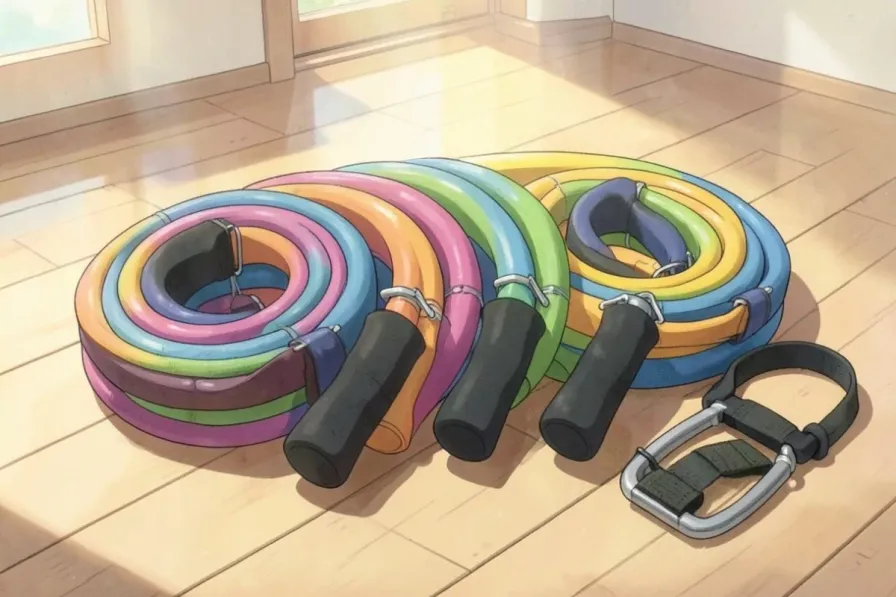
Resistance Bands for Shoulders: The Label Is Not Your Load

Search for resistance bands for shoulders and the same verdict comes back from every result: dumbbells build size, bands are for rehab and warm-ups. Almost none of those pages cite anything.
The research does not say that. What it says is more useful, and it changes what you should actually buy.
The Comparison Has Been Run
A systematic review and meta-analysis in SAGE Open Medicine pooled the trials that put elastic resistance directly against conventional resistance and found no superiority between the methods for either upper or lower limb strength.
One caveat worth stating, because it is the kind of thing that gets missed: that paper carries a 2020 corrigendum. The correction swapped the upper and lower limb results throughout the original abstract, and revised the number of included studies from eight to seven. The headline conclusion survived the correction intact, but the individual effect sizes as originally printed were mislabelled — which is why the numbers are not quoted here.
Shoulder-specific evidence points the same way. A trial in the Journal of Strength and Conditioning Research put 73 people through eight weeks of elastic resistance training, three sessions a week. Shoulder abduction strength rose by roughly 4% of body weight and external rotation by roughly 2%, in both arms of the study.
Read that one carefully, though. It compared elastic training with and without force feedback, not elastic against dumbbells. It tells you bands produce a measurable shoulder strength gain. It does not tell you they beat weights.
Put together: the deltoid is not checking what the tension is attached to.

So Why Does Everyone Say Bands Are Worse?
Because of the part that is actually true, and which nobody states precisely. The problem with bands is not the muscle. It is the number.
A study in the Journal of Physical Therapy Science measured the tension of eight colours of therapy band across ten degrees of stretch, from 25% to 250% of resting length, and published the reference values. Two things came out of it.
First, one band is not one load:
| Band | At 25% stretch | At 100% | At 200% |
|---|---|---|---|
| Red | 0.65 kgf | 1.60 kgf | 2.26 kgf |
| Green | 0.78 kgf | 1.82 kgf | 2.91 kgf |
The same red band delivers 0.65 kgf or 2.26 kgf depending on nothing but how far you pulled it — a 3.5-fold range within one band. Stand a foot closer to the anchor and you have changed the weight without meaning to.
Second, and more awkward for anyone selling bands: the measured tensions came in 13% to 44% below the manufacturer’s own stated values, across the colours tested. The number printed on the packaging was consistently optimistic.
The relationship itself is tidy — force rose linearly with stretch, with R² between 0.958 and 0.997 — so band tension is perfectly knowable. It is just not knowable from the label.

What That Means for Shoulders Specifically
Shoulders are where this bites hardest, because the shoulder is trained with small loads and small jumps.
A lateral raise might live at 5 to 15 lb for years. Going up by 5 lb on a lateral raise is a 30% to 50% jump in load, which is enormous. That is why shoulder progression is fussy in a way that leg progression is not, and it is why “my band says 30 lb” is close to useless information: you cannot tell a 10% increase from a 40% one by feel.
A dumbbell solves that specific problem and nothing else. Fifteen pounds is fifteen pounds at the bottom of the raise, at the top, and next March.

How to Progress With Bands Anyway
None of the above means resistance bands for shoulders do not work. It means you have to make the load repeatable yourself, since the label will not do it for you.
- Fix the geometry. Mark where you stand and where the anchor sits. Same start position every session, or you are not repeating the exercise, you are just doing something similar.
- Progress by stacking, not by stretching further. Adding a second band is a step you can name and repeat. Standing further away is a step you cannot.
- Let reps carry the progression between steps. Because the jumps between bands are coarse, reps and controlled tempo are what fill the gap.
- Do not try to convert bands to pounds. Given the 13-44% overstatement, any conversion you do is built on a number the manufacturer already inflated.
What to Buy, and What Each One Is Bad At
As an Amazon Associate I earn from qualifying purchases.
If you want the cheapest thing that trains shoulders properly: the WHATAFIT Resistance Bands set. Five bands rated 10, 20, 30, 40 and 50 lb that clip together, with a door anchor, and it holds 4.6 stars across roughly 36,000 ratings at the time of writing.
Now the honest part, which follows directly from the research above: treat those poundage ratings as labels, not measurements. The published work found stated values running 13% to 44% high, and in any case the rating cannot describe a force that changes as you stretch. Use the bands as five repeatable steps that get harder in order. That is what they genuinely are, and for shoulder work it is enough.
If you want a load you can actually name: the FEIERDUN DS2 Adjustable Dumbbells set. It holds 4.4 stars across about 5,000 ratings.
Read its spec sheet carefully, because the listing headline says 90 lbs and that is the barbell configuration, not what you press overhead in one hand. The manufacturer’s own description puts the single dumbbell at 6 to 22.5 lb. For shoulders that is the relevant range rather than a limitation — most people will spend their entire training life doing lateral raises inside it — but if you came looking for a 90 lb dumbbell, this is not that.
If you can only buy one and shoulders are the goal: start with the bands. The shoulder is trained with tension, not with impressive numbers, and the evidence does not support paying three times more for the privilege of knowing what the number is. Buy the dumbbells when you find yourself wanting to track the number rather than just wanting the training effect.
Where This Fits
For the actual movements, the home shoulder workout guide covers the exercise selection this article deliberately skips. If you are building a session rather than a single muscle, compound exercises is the place to start, and lengthened partial reps is relevant here because band tension is at its lowest exactly where the muscle is longest — the opposite of where recent work suggests the useful stimulus sits.
If you have a shoulder that hurts rather than a shoulder that is untrained, none of this applies and the order of operations is a clinician first.
Frequently Asked Questions
Can you actually build shoulders with resistance bands? Yes. A meta-analysis in SAGE Open Medicine found no superiority between elastic and conventional resistance for upper or lower limb strength, and an eight-week trial of 73 people using elastic resistance raised shoulder abduction strength by roughly 4% of body weight. The limitation of bands is measurement, not muscle.
Is a 30 lb resistance band really 30 lb? No, on two counts. Measured tension of therapy bands came in 13% to 44% below the manufacturer’s stated values in published reference testing. And a band has no single load at all: the same red band produced 0.65 kgf at 25% stretch and 2.26 kgf at 200%, so the force depends on how far you pull it.
Are bands or dumbbells better for lateral raises? For the training effect, neither is clearly better. For tracking progress, dumbbells are, because a lateral raise progresses in very small steps and a 5 lb jump is already a 30-50% increase at typical raise loads. With bands you cannot tell a 10% increase from a 40% one, so progress by stacking bands rather than by standing further from the anchor.
How do you progressively overload with resistance bands? Fix your foot and anchor positions so the stretch is repeatable, then progress by adding a band rather than by stepping further away. Steps between bands are coarse, so use reps and controlled tempo to fill the gap between them. Avoid converting band tension to pounds, since the stated ratings are already inflated.
Why does band tension change during the movement? Because force rises with elongation. Published testing across eight band colours from 25% to 250% stretch found the relationship is close to linear, with R-squared between 0.958 and 0.997. That makes band tension predictable from how far it is stretched, but not from the number printed on it.
Do I need both bands and dumbbells for shoulders? No. If shoulders are the goal and you buy one thing, bands are the cheaper option and the evidence does not support paying more for the same training effect. Add adjustable dumbbells when you want to track a load in a number rather than in repeatable steps.
Evandro
Evandro is the founder of The Fitness Road. He believes that without physical activity there is no real health, and without health, there is no lasting discipline in any other area of life.
Leave a Reply
Your email address will not be published. Required fields are marked *