Progressive Overload: The Honest Secret to Getting Stronger

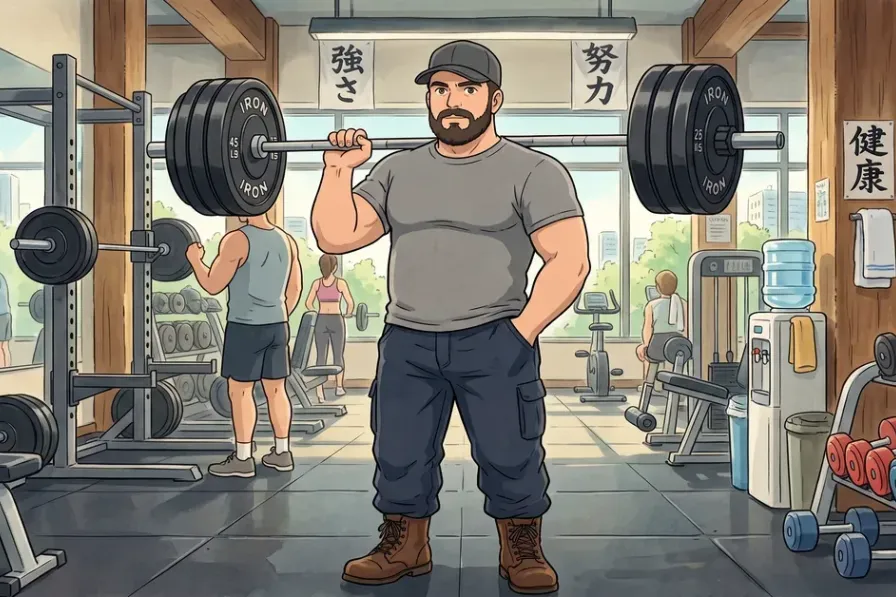
Progressive overload is the practice of gradually increasing the demand on your muscles over time — more weight, more reps, or more total work — so your body has a reason to keep adapting. It is the single principle that separates people who get stronger from people who train for years and stay exactly the same, regardless of how hard either group feels like they’re working. If you remember nothing else from this article, remember that one idea.
Everything else here is just the practical detail on how to apply it without wasting months guessing. That bold paragraph is the whole article in four sentences.
Everything below is how to actually do it without guessing, backed by what the research actually says rather than whatever the loudest guy in the gym happens to believe that week.
Why nothing changes without it
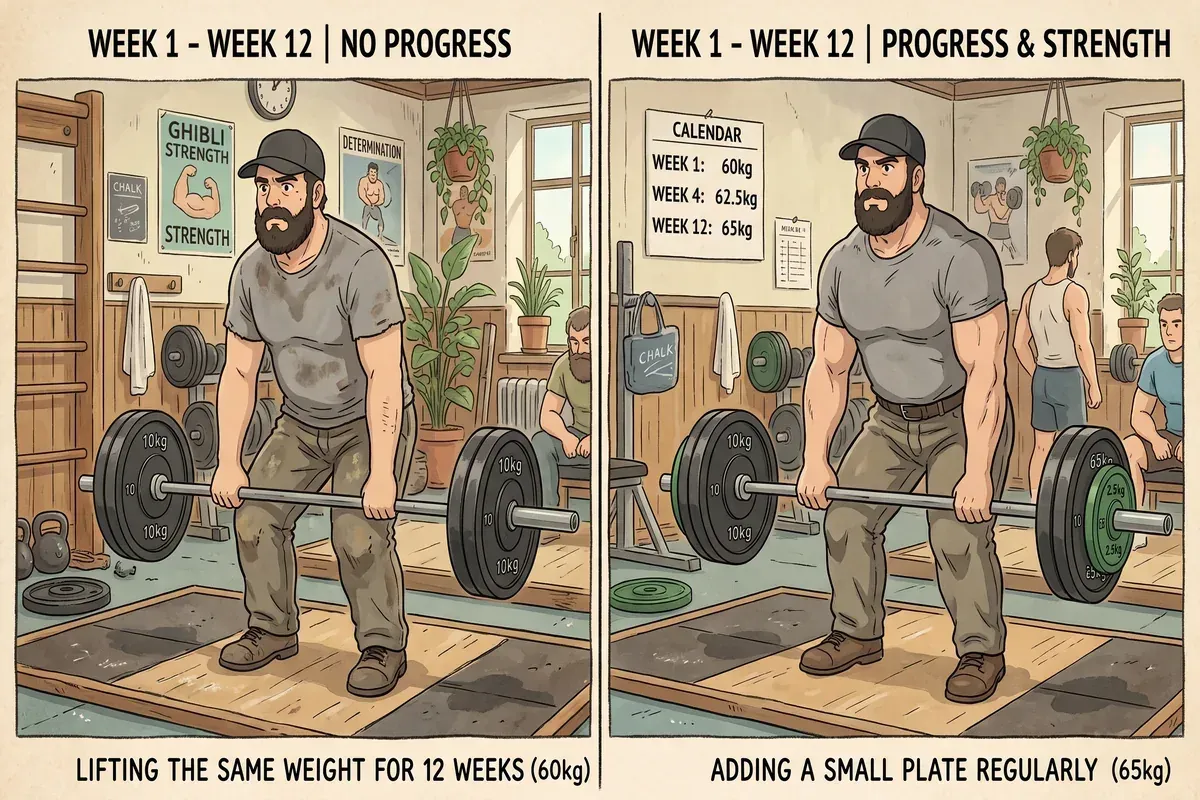 Here’s the uncomfortable truth most people avoid: your body only changes when you force it to. Lift the same weight for the same reps every week and your muscles have zero reason to grow or get stronger — you’ve told them the current version of you is enough for the job. The strong, unassuming person you notice at the gym isn’t gifted. They’ve simply been making the job slightly harder, over and over, for a long time.
Think of it like carrying grocery bags. Carry the same two bags every week for a year and your arms won’t get noticeably stronger, because you’ve already adapted to that exact load. Add one more bag every few weeks instead, and your body has no choice but to keep up.
Training works the same way, just with a barbell instead of groceries. The 2026 American College of Sports Medicine position stand — built from 137 systematic reviews and more than 30,000 participants — is blunt about how much this matters. For most people, straightforward progressive overload does the bulk of the work, and complicated periodization schemes don’t reliably beat it. [1] In plain terms: you don’t need a fancy program. You need to keep nudging the difficulty up.
The 6 ways to apply progressive overload
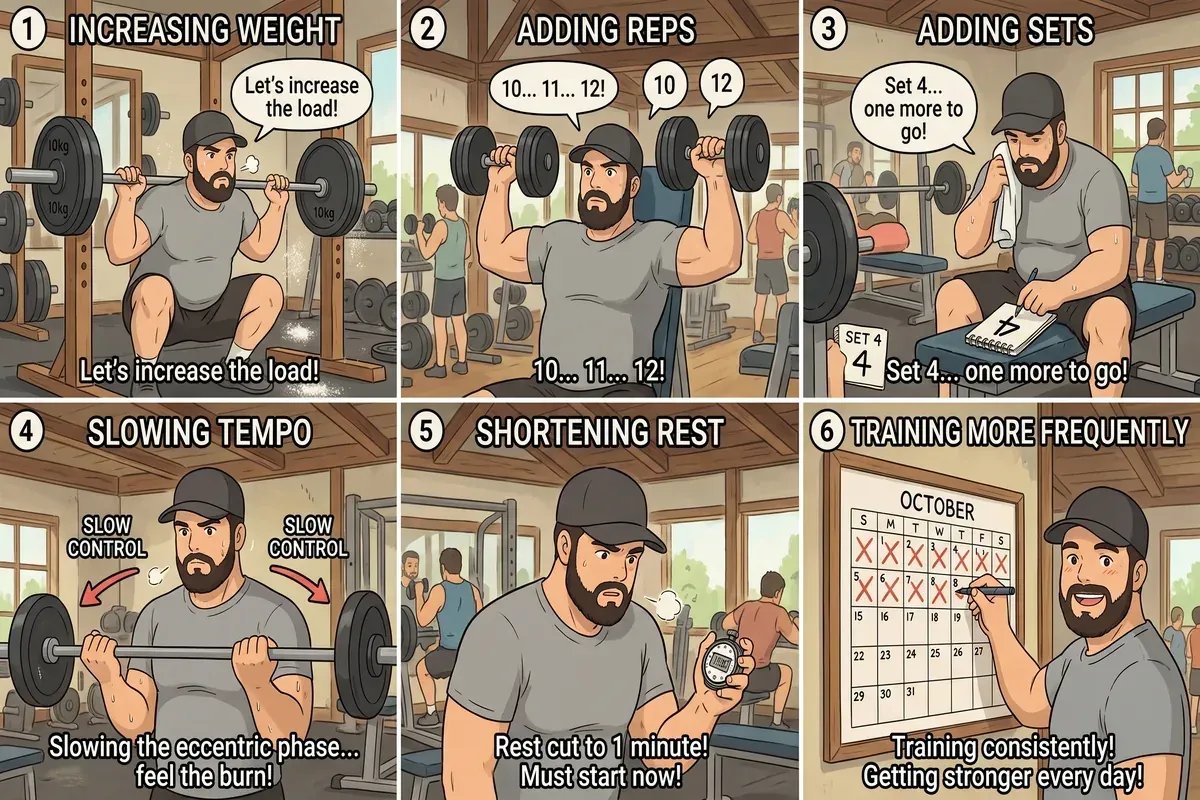 Adding weight is the obvious one, but it’s not the only lever. When the bar won’t move up, you can still progress in five other ways. These are your options:
- Add weight. The classic and most obvious lever. When a set feels comfortable, put a little more weight on the bar next time you train.
- Add reps. Same weight, one or two more reps than last session. This is often smarter than jumping the weight too soon.
- Add sets (total volume). An extra working set adds more total work, which is a major driver of progress over time.
- Slow the tempo or improve range of motion. A deeper squat or a controlled three-second lower makes the same weight harder — and safer.
- Shorten rest (carefully). Doing the same work in less time raises the demand. Use this for conditioning, not for your heaviest strength sets.
- Add frequency. Training a muscle group a bit more often across the week increases weekly volume, which research links to better results. [2]
You don’t use all six at once. You pick whichever one actually fits where you’re currently stuck, then move on to the next when that one stops working.
How to apply progressive overload week to week (the practical version)
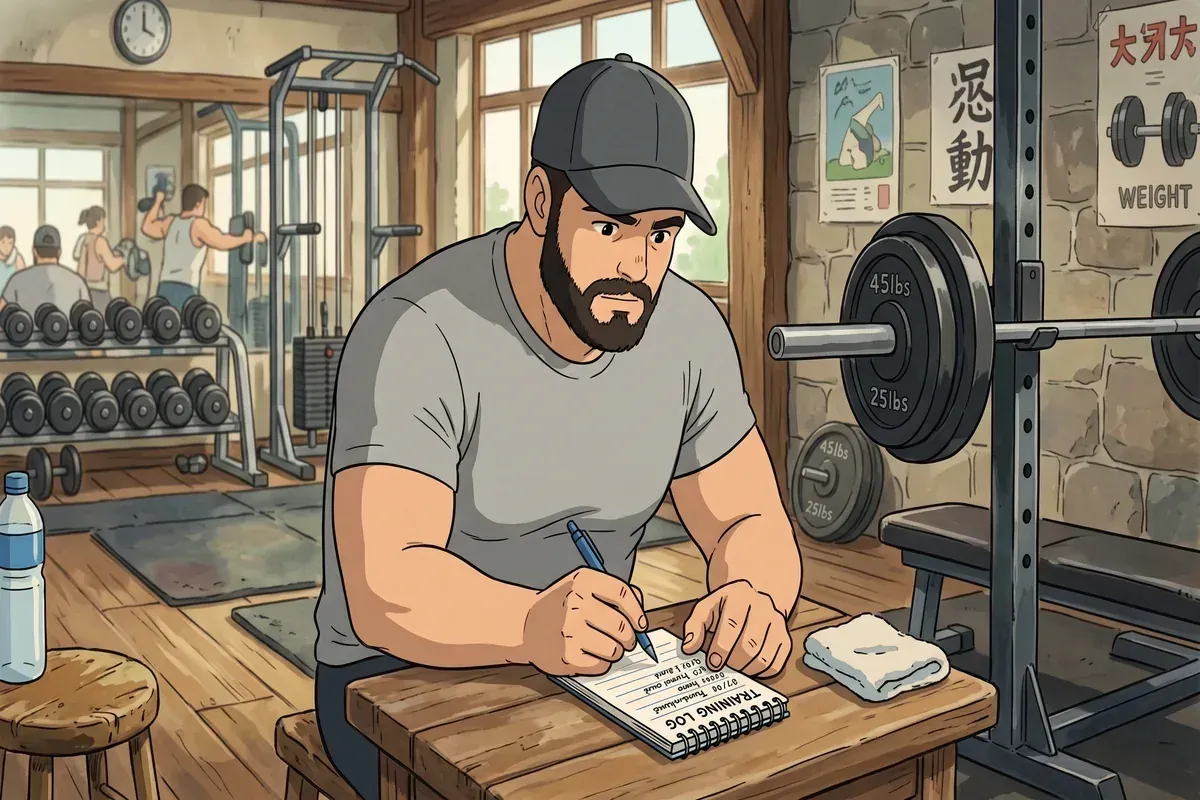 The mistake beginners make is trying to add weight every single session until they stall in a month. Here’s a more durable approach.
Use small jumps. For most lifts, adding the smallest available increment — often 2.5 to 5 lb / 1 to 2.5 kg — is plenty. Tiny, boring progress that you keep is worth more than big jumps that wreck your form.
Try double progression. Pick a rep range, say 6 to 8. Stay at the same weight until you can do the top of the range (8) on every set with good form. Then add weight and drop back to the bottom of the range (6). Climb again. Repeat. This gives you a clear, self-guiding rule for when to move up.
Leave a rep or two in the tank. You don’t have to grind every set to failure to progress. The ACSM review found that stopping about two to three reps short of failure produces the same strength and size gains as going all-out — with less fatigue and lower injury risk. [1] That’s the sweet spot for adding load sustainably.
Log your lifts. You genuinely cannot progressively overload what you don’t track in some way, even loosely. A notes app with your weights and reps turns “I think I’m getting stronger” into proof, and it tells you exactly what to beat next time.
The mistake beginners make is trying to add weight every single session until they stall in a month. Here’s a more durable approach.
Use small jumps. For most lifts, adding the smallest available increment — often 2.5 to 5 lb / 1 to 2.5 kg — is plenty. Tiny, boring progress that you keep is worth more than big jumps that wreck your form.
Try double progression. Pick a rep range, say 6 to 8. Stay at the same weight until you can do the top of the range (8) on every set with good form. Then add weight and drop back to the bottom of the range (6). Climb again. Repeat. This gives you a clear, self-guiding rule for when to move up.
Leave a rep or two in the tank. You don’t have to grind every set to failure to progress. The ACSM review found that stopping about two to three reps short of failure produces the same strength and size gains as going all-out — with less fatigue and lower injury risk. [1] That’s the sweet spot for adding load sustainably.
Log your lifts. You genuinely cannot progressively overload what you don’t track in some way, even loosely. A notes app with your weights and reps turns “I think I’m getting stronger” into proof, and it tells you exactly what to beat next time.
A quick example of double progression in action
Say you’re bench pressing and working in the 6 to 8 rep range. Week one, you hit 6, 6, 6 across three sets.
Week two, still with the same weight, you push to 7, 7, 6. Week three you finally get 8, 8, 8 on all three sets with solid form.
That’s your signal: add the smallest plate available, drop back down to 6 reps at the new weight, and start climbing again. No guessing, no ego, just a clear rule that tells you exactly when to move up.
Common progressive overload mistakes
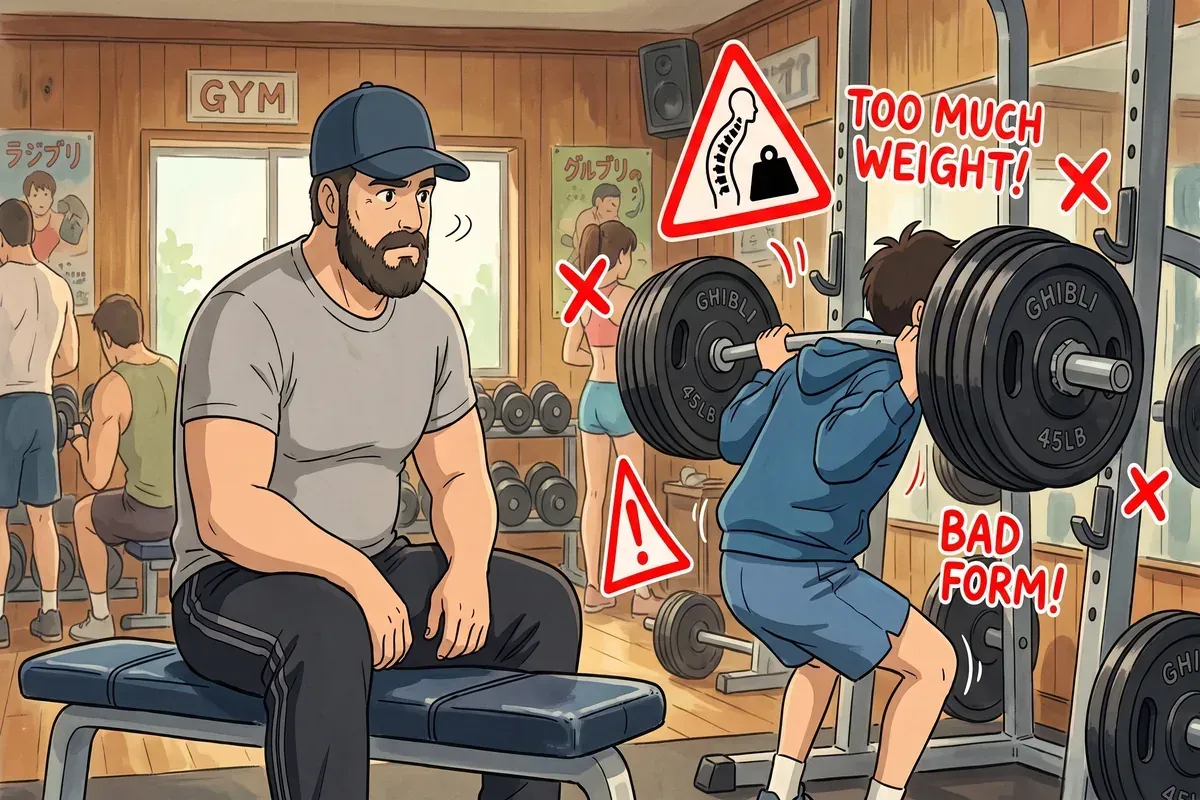
- Adding weight too fast. Ego lifting turns a good principle into an injury. If your form breaks down, you’ve added too much.
- Only ever adding weight. When the bar stalls, people quit instead of adding a rep or a set. Use the other five levers.
- Program hopping. Switching routines every two weeks resets your progress. Progressive overload works because it’s repeated on the same movements for months.
- Ignoring recovery. You adapt between sessions, not during them. Undereating and undersleeping stall progress no matter how disciplined your training is.
- Expecting a straight line. Some weeks you’ll add weight, some weeks you’ll repeat the same numbers, and that’s still progress. Strength doesn’t increase in a perfectly straight line for anyone.
— Related: the lifts worth overloading are the big compound exercises — they let you add load for years. — Just starting? Build the base first with a beginner gym workout plan. No barbell?
Progressive overload still applies. With bodyweight training, you overload by moving to a harder exercise variation, slowing the tempo, adding reps, or reducing rest between sets instead of adding plates.
A push-up progresses to a decline push-up, then eventually a one-arm push-up, using the exact same principle as a heavier bench press.
Tracking makes this easier than it sounds
You don’t need a fancy app to apply any of this.
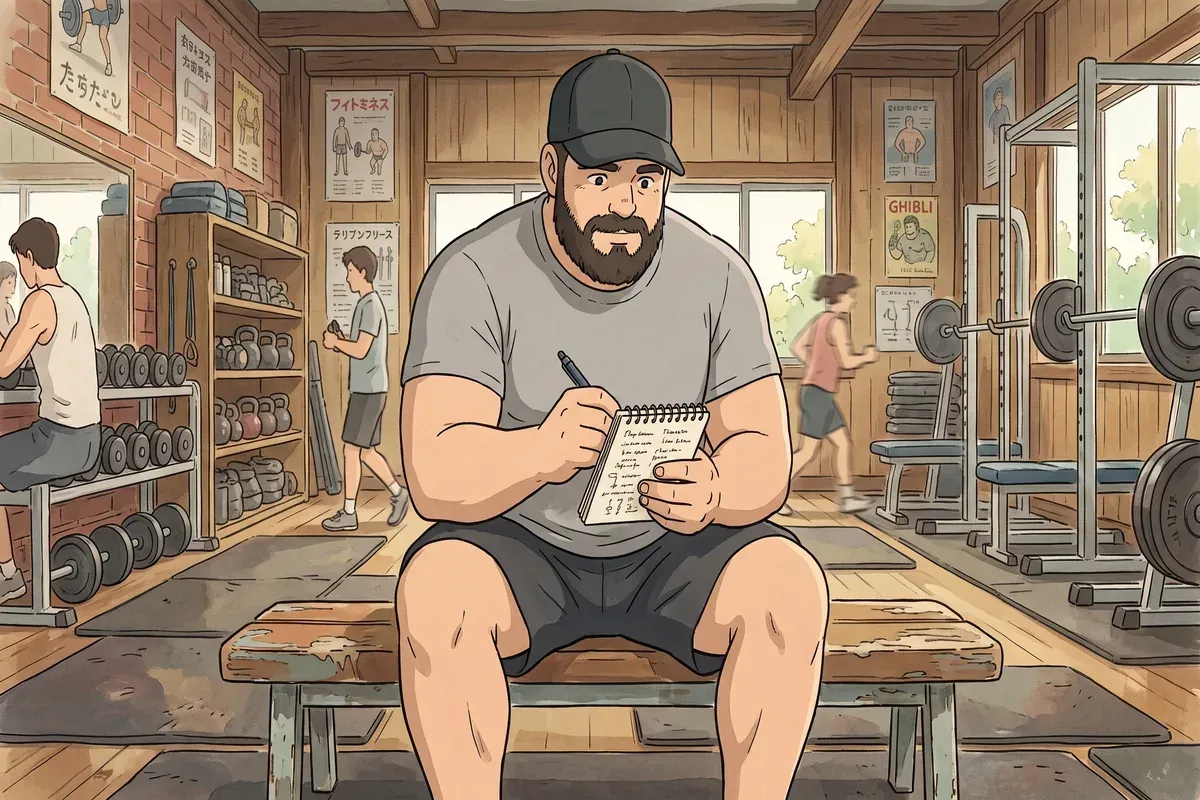
A simple notes file with the date, exercise, weight, and reps for each set is enough. Before every session, glance at what you did last time and try to beat it in some small way, whether that’s one more rep, a slightly heavier weight, or one more set.
That single habit, checking last time and trying to edge past it, is progressive overload in its simplest form, and it works whether you’ve been training for two weeks or twenty years.
How long until you see results?
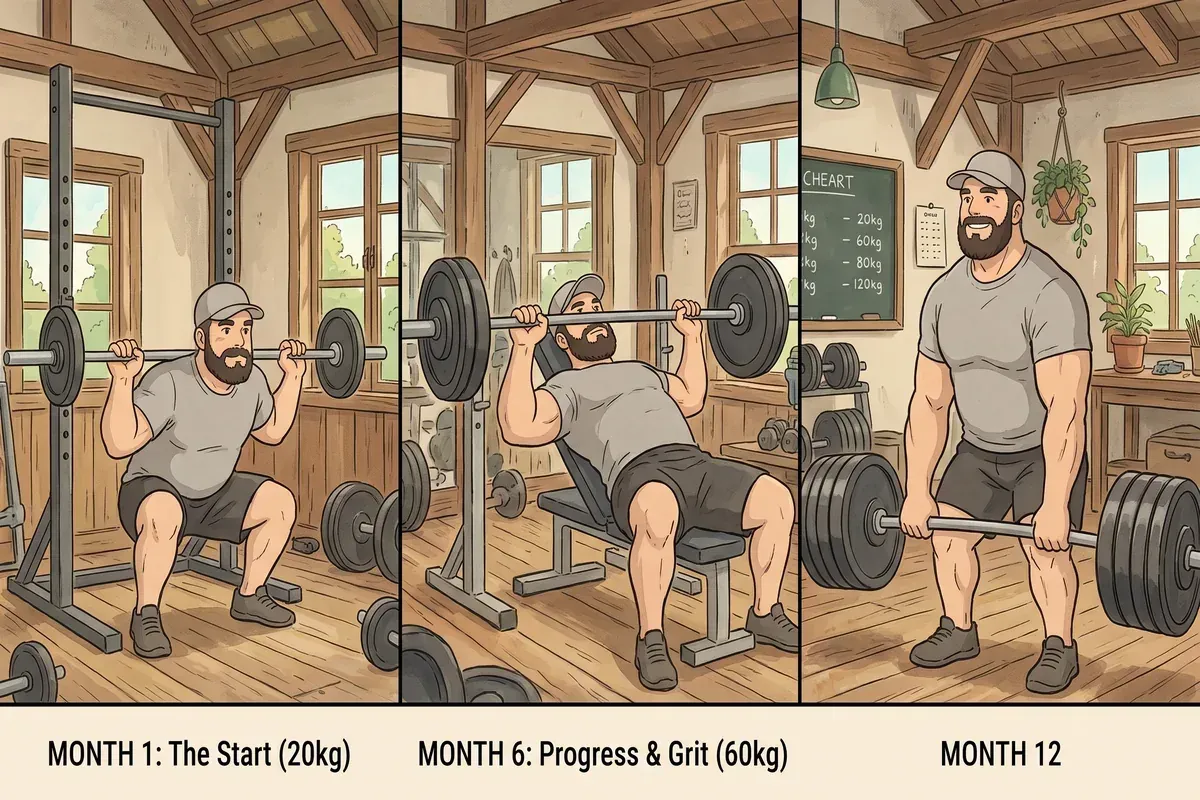 Honestly? Longer than any ad wants you to believe, and that’s fine.
Early strength gains often come within the first several weeks, but a lot of that is your nervous system getting better at the movement before your muscles visibly change. Real, lasting progress is measured in months and years of small, boring, repeated additions.
There’s no responsible way to promise a number, and anyone who does is selling something. The good news is that the method is simple and it works for almost everyone who sticks with it.
Frequently asked questions
What is progressive overload in simple terms? It’s gradually making your workouts a little harder over time — by adding weight, reps, or sets — so your body keeps adapting instead of settling.
How much weight should I add each week? As little as the smallest plate allows, usually 2.5—5 lb (1—2.5 kg) on bigger lifts. Slow and repeatable beats big and reckless.
Can beginners use progressive overload? Yes — beginners progress fastest of all because almost any consistent increase is new stimulus. Just prioritize form before load.
Do I have to lift to failure? No. Stopping two to three reps short of failure gives the same results with less fatigue and injury risk, according to current ACSM guidance. [1]
What if I hit a plateau and nothing seems to work? Double check sleep, food, and whether you’re actually adding difficulty over time rather than repeating the same numbers out of habit. Most plateaus trace back to one of those three, not to needing a completely new program.
References
- American College of Sports Medicine. Resistance Training Prescription for Muscle Function, Hypertrophy, and Physical Performance in Healthy Adults (2026 Position Stand). acsm.org
- Schoenfeld BJ, Ogborn D, Krieger JW. Effects of Resistance Training Frequency on Measures of Muscle Hypertrophy: A Systematic Review and Meta-Analysis. Sports Medicine, 2016. Springer
*The Fitness Road shares general fitness information, not medical or coaching advice.
We’re enthusiasts, not doctors or licensed trainers. Talk to a qualified professional before starting a new program, especially if you have an injury or health condition, and stop any movement that causes pain.
Questions? contact@thefitnessroad.com*
Evandro
Evandro is the founder of The Fitness Road. He believes that without physical activity there is no real health, and without health, there is no lasting discipline in any other area of life.
Leave a Reply
Your email address will not be published. Required fields are marked *