
How Much Salt in a Homemade Electrolyte Drink? Weigh It

Nearly every recipe for a homemade electrolyte drink ends on the same instruction: add a quarter teaspoon of salt to a litre of water. Most then tell you that lands you somewhere around 500 to 600 mg of sodium.
That figure is right for one kind of salt. Use a different one and the identical quarter teaspoon delivers barely half as much — which means how much salt in a homemade electrolyte drink really contains depends on which box is in your cupboard, not on the recipe you followed.
One Brand, One Spoon, Two Different Doses
The clearest way to see this is not to compare rival brands. It is to look at three products from the same company. These are Cargill’s own label figures, filed under its Diamond Crystal salt business in USDA FoodData Central:
| Cargill / Diamond Crystal product | A 1/4 tsp serving weighs | Sodium |
|---|---|---|
| Kosher Salt (FDC 2571981) | 0.7 g | 280 mg |
| Salt Sense (FDC 1503820) | 1.0 g | 390 mg |
| Red Cross Iodized Salt (FDC 1475842) | 1.5 g | 590 mg |
Same manufacturer, same declared serving of a quarter teaspoon, and the sodium runs from 280 to 590 mg. A 2.1-fold spread inside a single company’s own catalogue.
Morton’s published labels land in the same territory: iodized table salt is 1.5 g and 590 mg per quarter teaspoon, while coarse kosher salt is 1.2 g and 480 mg.
So when a recipe says “a quarter teaspoon of salt”, it is not specifying a dose. It is specifying a gesture.
It Is Not the Salt. It Is the Air Between the Crystals
The intuitive explanation is that kosher salt must be somehow less salty. It is not.
Sodium chloride is 39.3% sodium by mass — sodium’s atomic mass is 22.99 against 58.44 for the whole compound. USDA lists all three Cargill products above at 39 to 40 g of sodium per 100 g, which is the same compound in the same proportion every time.
What changes is how much salt fits in the spoon. Table salt is a dense pack of small cubes. Kosher salt is built from large irregular flakes that stack badly and trap air in the gaps. You are measuring volume when the thing that matters is mass, and the conversion between them is a property of the crystal, not of the chemistry.
That is why the quarter-teaspoon advice has survived unchallenged for so long. It is not wrong, exactly. It is silently assuming a salt you may not own.
What the Number Should Be
For long efforts, the ISSN position stand on ultra-marathon training and racing is direct: runners should take sodium “in concentrations of 500-700 mg·L⁻¹ of fluid.”
Convert that back into salt at 39.3% and you get 1.3 to 1.8 g of salt per litre, by weight, whatever is in your cupboard.
Now put the two halves together:
- Table salt, quarter teaspoon per litre: 590 mg. Inside the range.
- Morton coarse kosher, quarter teaspoon: 480 mg. Slightly under.
- Diamond Crystal kosher, quarter teaspoon: 280 mg. About 44% below the bottom of the range. Landing inside it takes closer to half a teaspoon.
One instruction, three outcomes, and only one of them is what the recipe intended.
The Part Recipes Leave Out
Even a correct target is a population average, and sweat is not average.
A study of 157 experienced marathon runners published in the Journal of the International Society of Sports Nutrition measured sweat sodium at 42.9 ± 18.7 mmol·L⁻¹, with individual values spanning 7.0 to 95.5 mmol·L⁻¹. At sodium’s atomic mass that is roughly 160 to 2,200 mg of sodium per litre of sweat depending on the person.
A 13-fold difference, in one sport, in one study. Two people finishing the same session can have genuinely different needs, and no recipe can know which one you are.
That is not a reason to ignore the published range. It is a reason to treat 500-700 mg/L as a starting point you adjust from rather than a prescription. If long sessions leave white salt rings dried on your skin and your kit, you are likely at the upper end. If they never do, you are probably not.
Weigh It Once, Then Never Again
The fix is not a better teaspoon conversion. It is to weigh the salt — but there is a catch that makes the usual “just get a kitchen scale” advice fall over.
A single serving of salt is one to two grams, which sits at the very bottom of what a kitchen scale can resolve. The popular Etekcity model states it in its own specifications: 0.1 g increments below 1000 g, but a minimum measurement of 1 g. A quarter teaspoon of Diamond Crystal kosher weighs 0.7 g. That scale cannot weigh it at all.
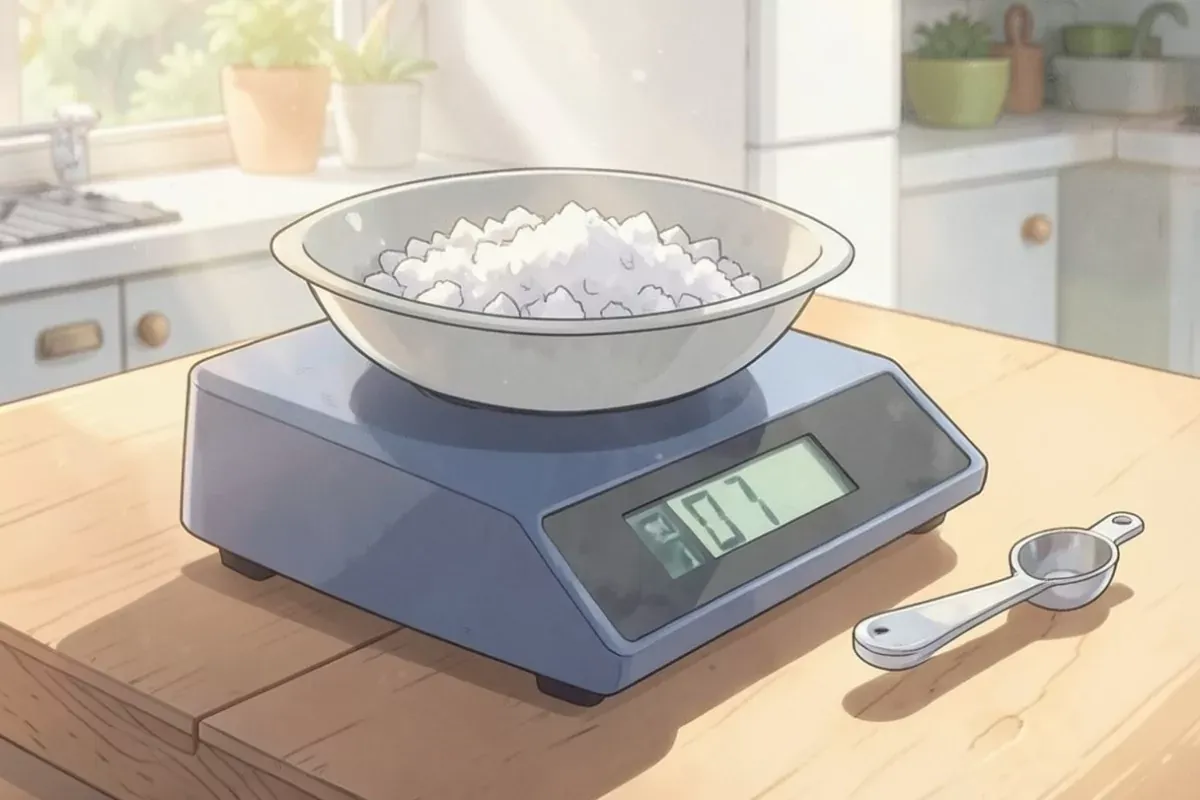
So do not weigh one serving. Calibrate your spoon once:
- Level off your measuring spoon into a bowl on the scale — ten times, ten quarter teaspoons.
- Read the total. Expect roughly 7 g for Diamond Crystal kosher, 12 g for Morton coarse kosher, 15 g for table salt.
- Divide by ten. That is what a quarter teaspoon of your salt actually weighs.
Ten scoops puts the reading between 7 and 15 g, comfortably inside the range where the scale is accurate, and it settles the question permanently. You now know your own conversion and can go back to using the spoon forever. From that point on, how much salt in a homemade electrolyte drink you are actually getting stops being a guess and becomes arithmetic. The scale earns its keep in a single afternoon.
If you would rather work from the target: divide 1,300 by your per-scoop weight in milligrams for the number of scoops at the low end of the range, and 1,800 for the high end.
Precision in One Variable Is Wasted Without the Other

There is a second half to this, easy to miss. Sodium targets are written per litre. Weigh your salt to a tenth of a gram and then pour the water in by eye and you have gained nothing — you have moved the error from the salt to the water.
Most bottles sold as one litre are 32 oz, which is 946 mL, not 1,000. That is a 5% error before you start, and many bottles carry no volume markings at all. The motivational bottles that dominate the search results are mostly printed with times of day — “8 AM”, “10 AM” — which are drinking reminders, not measurements, and are no use here.
What you want is a bottle with real graduations moulded into the wall.
What Is Actually Worth Buying
As an Amazon Associate I earn from qualifying purchases.

Two items, and only two, because that is all this needs.
For the weighing: the Etekcity 0.1g Food Kitchen Scale reads in 0.1 g steps up to 1000 g and holds 4.7 stars across roughly 59,000 ratings at the time of writing. Its limitation is the one described above, and it is the manufacturer’s own published figure — it will not register anything under 1 g. For the ten-scoop calibration that does not matter. If you specifically want to weigh single one-gram doses, this is the wrong tool and you want a 0.01 g jeweller’s scale instead.
For the volume: the Nalgene 32 oz Wide Mouth has millilitre and ounce lines moulded into the wall, which the manufacturer lists as being for “mixing in drink powders” among other uses, and sits at 4.8 stars across about 25,000 ratings. Two honest caveats. It holds 32 oz, so read the mL graduation rather than assuming a litre, and scale the salt to the volume you actually filled. And if you already own a measuring jug with real markings, you do not need this — the jug does the identical job.
Neither of these makes the drink work better. They make the number you intended the number you actually get, which is the entire point.
Where This Fits
If you are mixing electrolytes because of cramping, the ingredient side is covered in electrolyte drinks for muscle cramps — treat the quarter-teaspoon figure there as the starting point this article calibrates. For what to drink mid-session there is intra-workout drinks, and for afterwards, DIY recovery drinks.
One thing worth stating plainly: if you have high blood pressure, kidney disease, or you are on a sodium-restricted diet for any reason, none of this is aimed at you. Deliberately adding sodium is a conversation for your doctor first.
Frequently Asked Questions
How much salt should I put in a homemade electrolyte drink? By weight, 1.3 to 1.8 g of salt per litre of water gives 500 to 700 mg of sodium, the range the ISSN ultra-marathon position stand sets out for endurance efforts. By volume it depends on your salt: about a quarter teaspoon of table salt, but closer to half a teaspoon of Diamond Crystal kosher salt for the same sodium.
Does kosher salt have less sodium than table salt? Not by weight. Both are sodium chloride and both are about 39% sodium by mass. The difference is density. Kosher salt’s large flakes trap air, so a spoon holds less salt. Cargill’s own labels show a quarter teaspoon of its kosher salt weighing 0.7 g against 1.5 g for its iodized salt, which is why the sodium comes out at 280 mg against 590 mg.
Why does every recipe say a quarter teaspoon? Because it is right for table salt, which is what those recipes assume. Morton iodized table salt gives 590 mg of sodium per quarter teaspoon, inside the usual target range. The advice does not carry across to kosher or flaked salts, and almost no recipe states which salt it meant.
Can a normal kitchen scale weigh one gram of salt? Often not. Many popular kitchen scales, including the Etekcity 0.1 g model, publish a minimum measurement of 1 g, so a 0.7 g quarter teaspoon of kosher salt will not register at all. Weigh ten scoops at once and divide by ten instead, which puts the total well inside the scale’s accurate range.
Is there one correct sodium amount for everyone? No. A study of 157 marathon runners found sweat sodium ranging from 7.0 to 95.5 mmol/L between individuals, roughly 160 to 2,200 mg per litre of sweat. Published ranges are a starting point to adjust from. Heavy salt residue on skin and clothing after long sessions suggests you sit at the higher end.
Do I need a special bottle to mix it? You need something with real volume graduations, which many sports bottles lack. The popular motivational bottles are marked with times of day, not millilitres. A measuring jug from your kitchen works just as well. Note also that a 32 oz bottle holds 946 mL, not a litre, so scale the salt to it.
Evandro
Evandro is the founder of The Fitness Road. He believes that without physical activity there is no real health, and without health, there is no lasting discipline in any other area of life.
Leave a Reply
Your email address will not be published. Required fields are marked *